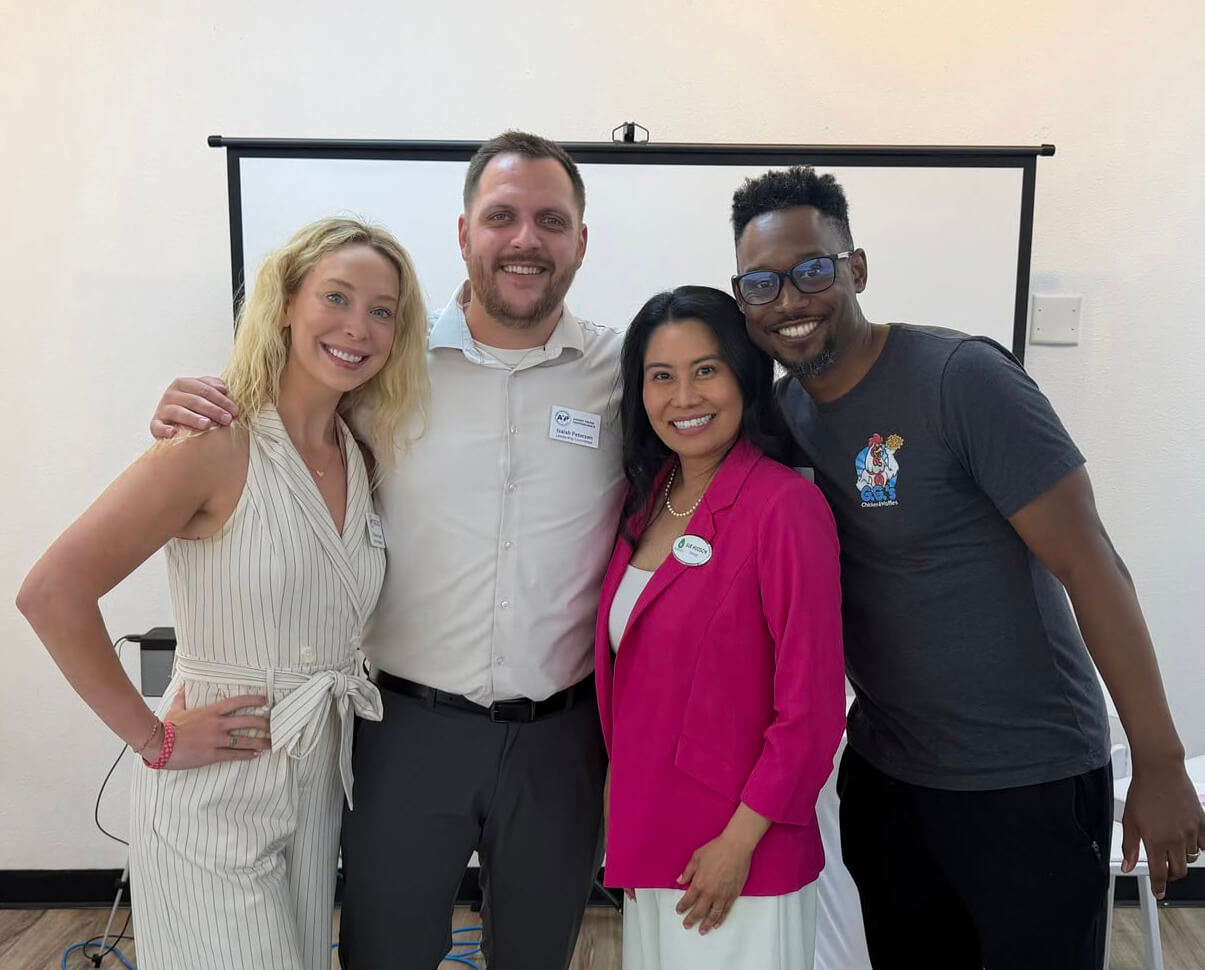
During a recent June Ankeny Young Professionals Lunch & Learn moderated by AYP Chair Nicole Strom, three local business owners shared stories from their entrepreneurial journeys and offered practical advice for anyone considering starting a business of their own. For Sue Hudson Garrison Goodlett and Dr. Isaiah Petersen, that leap involved risk, long hours, unexpected setbacks, and a willingness to know when to quit and bounce back.
Written by Mackenzie Cowden after the Ankeny Young Professionals June 2026 Lunch & Learn
What inspired you to start your business?
For Sue, entrepreneurship was a long-term goal. After earning a business degree, she spent years teaching marketing & business administration before realizing she wanted to practice what she was teaching. “I didn’t want to teach theory forever,” Sue said. “I wanted to do it myself.” Her entrepreneurial path eventually led her into real estate and property management, where she opened Hudson Property Management. After struggling with COVID, she transitioned to functional health and became the owner of IV Nutrition.
Garrison’s inspiration came from an unexpected experience. While visiting Los Angeles, he and his wife waited nearly an hour to eat at a famous chicken-and-waffles restaurant. After finally getting their food, they left disappointed.
“I thought, ‘This is it?'” Garrison said. “That’s when the seed was planted that maybe I could do this as well as they do.” He returned home, applied for the Downtown Des Moines Farmers’ Market, and launched what would become G.G.’s Chicken & Waffles.
For Isaiah, entrepreneurship was simply part of who he was. Growing up in a small town, he mowed lawns, scooped snow, and looked for ways to earn money. After graduating from chiropractic school, he opened his own practice, Feel Good Chiropractic & Wellness, rather than pursuing traditional employment. As Isiah noted, “Entire businesses are born not from a brand-new idea, but just a better way to do the same thing.” Isiah later opened Safe Water Iowa LLC.
What surprised you most after becoming a business owner?
“As an employee, I just had to be good at one thing,” Sue said. “As a business owner, I had to learn everything.” This list includes: Insurance, human resources, legal requirements, payroll, operations, marketing, and customer service, which suddenly all became her responsibility.
Garrison echoed that sentiment. “When you’re starting a business, you’re going to have your hands in all kinds of things,” he said. He encouraged aspiring entrepreneurs to find mentors who can help navigate challenges and shorten the learning curve.
Isaiah recalled opening his chiropractic office and assuming customers would simply appear. “I thought I could just open up and people would be happy to walk through the doors,” he said. Instead, he quickly discovered the importance of marketing, communication, and customer acquisition. He stressed the importance of spending time with people and understanding what motivates them. “People don’t care about your product,” Isiah said. “They care about solving their problem.”
“That first year was slow. But once customers began referring others, momentum started to build. I learned that one customer doesn’t just mean one,” Isaiah said. “One might mean 1.1 because they refer a friend.”
Sometimes there is a day when everything goes wrong.
For Sue, one of those days began with a fully booked schedule at her IV Nutrition clinic. After months of slow growth, she was excited about a full day of appointments. Then she arrived at work. Construction next door had filled the clinic with concrete dust. Contractors had accidentally damaged a sewer line, creating an overwhelming odor. To make matters worse, the internet was down.
“I was sitting there covered in dust, smelling the sewer, and couldn’t even call people to cancel appointments,” she said. Sue closed the clinic for the day, contacted customers, paid her staff, and spent several days cleaning. The experience reinforced an important lesson. “You have to be mentally strong,” she said. “Life will throw something at you, and you just have to know you can fix it.”
Garrison shared a similar story from his first Downtown Farmers’ Market appearance. Arriving before dawn to prepare food, he discovered he couldn’t access the commercial kitchen he needed. With the opening time approaching, his team searched for a solution until they found an unlocked entrance and gained access just in time. “It was a challenge,” he said. “But when things don’t go your way, don’t hit the panic button.”
What decision had the biggest impact on your business growth?
Sue found success by solving a frustration she experienced firsthand in the real estate industry. Homeowners associations often delayed paperwork needed for property closings, creating stress for agents and clients. Instead of accepting the problem, she built a business designed to provide faster service. Today, her HOA management company serves dozens of associations across the metro.
Garrison emphasized the power of relationships. “Being likable is really underrated. You have to give people positive experiences because people do business with people they like,” he said. By creating positive customer experiences and building genuine connections, he has generated referrals, partnerships, and opportunities that continue fueling growth.
Isaiah pointed to marketing as a turning point. Learning how to run Facebook advertising campaigns helped him attract customers and grow his practice. More importantly, he gained a skill that could be applied repeatedly across future business ventures. “So much of entrepreneurship is just learning skills,” Isiah said.
What skills should young professionals develop before starting a business?
Isaiah pointed to two critical areas: technology and human behavior. He encouraged young professionals to become comfortable using artificial intelligence and emerging technologies.
Sue encouraged future entrepreneurs to first identify their “why.” Business ownership demands significant sacrifices. She also emphasized time management, networking, and accepting failure as part of the process. “If you fail, it’s okay,” she said. “You will fail. You need to remember the good things you’ve done,” she said. “Those will get you through the hard days.”
Everyone highlighted relationship-building, preparation, adaptability, and learning from mistakes. Garrison advises, “You have to make connections,” he said. “You have to connect with people.” Those relationships often become the foundation for future success.
Sue credited networking with helping her navigate life as an immigrant adapting to a new community. “It opens doors,” she said.
Isaiah echoed that as you grow older, your social circle grows smaller, and you should “Keep as many doors open as possible. As careers evolve and responsibilities grow, networking remains one of the few ways to create new opportunities, open doors, and expand professional options.”
For these entrepreneurs, networking is more than collecting business cards. It is about building genuine relationships, creating trust, and staying connected to the community.
Follow the Ankeny Young Professionals on Facebook for upcoming event information!