


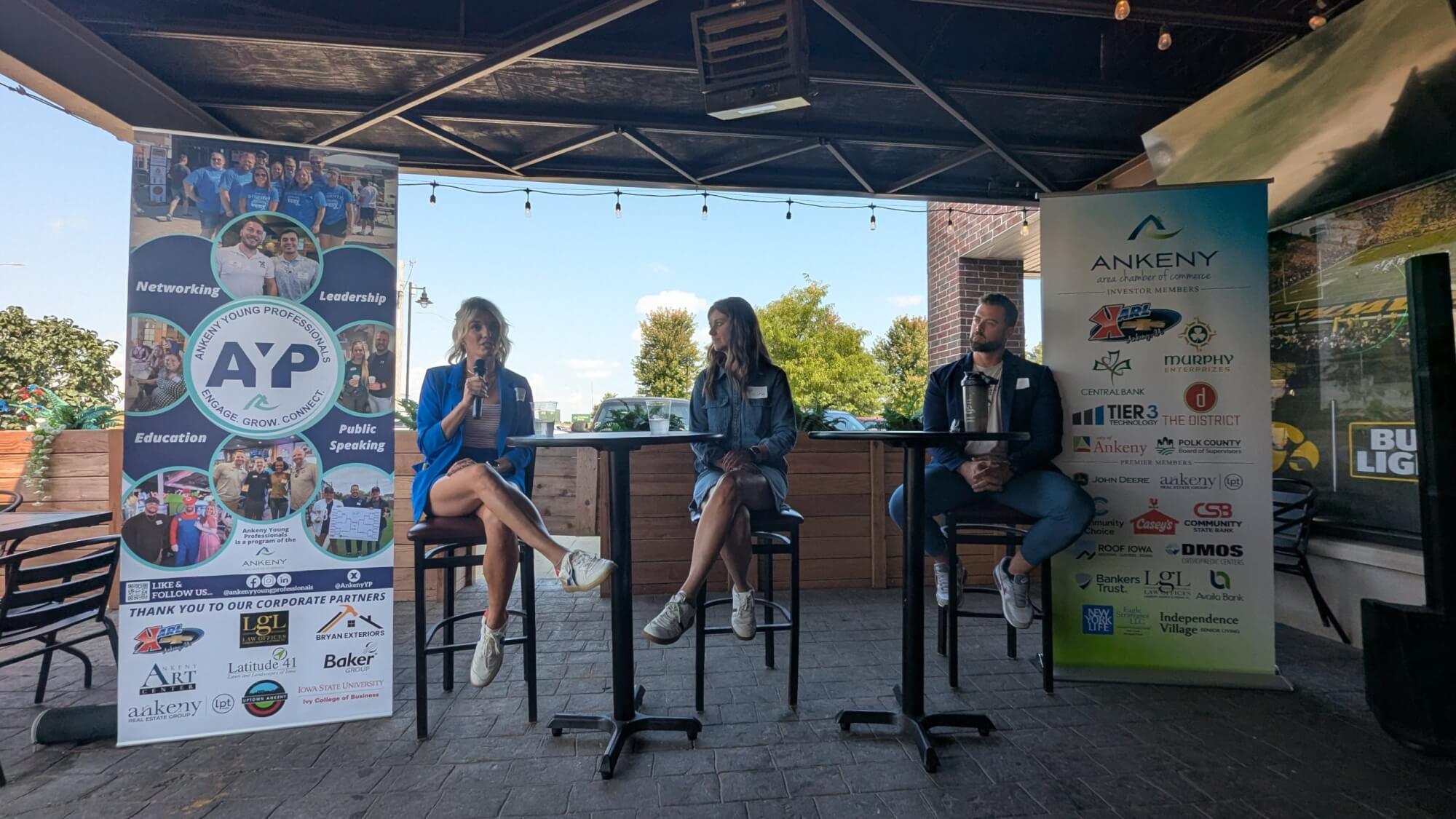
AYP September Lunch & Learn: Lessons in Entrepreneurship from Local Business Leaders
Written by Mackenzie Cowden, Director of Marketing and Graphic Design – Ankeny Area Chamber of Commerce
The Ankeny Young Professionals hosted its September Lunch and Learn at Cabaret Sports Bar & Grill to inspire aspiring entrepreneurs. The panel featured three local business owners who have each built something unique in our community. Tyler Robinson, co-owner of Krave Gym, Teressa Davis, owner of West Forty Market, and Lindsey Foss, owner of Real Deals Ankeny, shared their journeys, challenges, and advice.
Moderated by AYP Board Member Aleah Engel, this lively conversation was packed with real-world lessons about resilience, innovation, and the power of community. Here are some highlights from their discussion.
What inspired you to start your business?
Tyler Robinson, Krave Gym: My wife and I both have athletic backgrounds, and after college, we really missed the team environment that came with sports. We searched for a gym that offered strength and conditioning training with that same sense of community, and it just didn’t exist. So, we decided to create it ourselves. Twelve years ago, we opened our first Krave Gym in West Des Moines. Today, we have six locations, including one here in Ankeny.
We wanted to build a place where people could push themselves physically while feeling like part of a team. That vision has been our guiding light ever since.
Teressa Davis, West Forty Market: My journey started in a completely different career. My parents had a hobby farm. Once you’ve had high-quality, locally raised meat, it’s hard to go back to what you find in big-box stores. Years ago, I started selling my family’s beef at the Des Moines Farmers Market, literally delivering orders on my lunch breaks, or before and after work in dark alleys.
When I was laid off from my corporate job during the pandemic, I decided to take the leap. I invested my life savings into opening West Forty Market in Uptown Ankeny with a few freezers I found on FB marketplace. Today, we carry 250 to 300 cuts of meat from 8–10 Iowa farmers, plus hundreds of products from local makers. It’s become more than a store—it’s a way to connect people to Iowa farms and families.
Lindsey Foss, Real Deals Ankeny: I’ve always loved home décor. Growing up, I’d circle my dream house items in the JCPenney catalog. After working corporate jobs, I felt like a fly on the wall in my community. I craved connection. When I discovered Real Deals—a franchise with independently owned stores—I knew Ankeny needed one.
At first, I thought the three-day-a-week business model would be easy. Little did I know it was a 14-day-a-week commitment! But from day one, I loved the relationships. Customers came in to shop, yes, but they stayed because they felt seen and valued. That’s been my ‘why’ ever since.
What has been your toughest challenge as an entrepreneur?
Lindsey: We opened just 18 months before the pandemic hit. Suddenly, no one was buying boutique clothing because no one was going anywhere. We had to pivot fast to survive selling online, leaning into home décor and helping customers refresh their spaces while stuck at home.
But my ongoing challenge has been mindset. Small business doesn’t mean thinking small. Competing with big-box stores can feel overwhelming, but I remind myself to think beyond our four walls and focus on the experiences only we can provide.
Teressa: Pivoting is constant. The economy shifts month to month. Another challenge is building the right support team. I’ve gone through multiple accountants, bankers, and vendors to find the ones who really understand my business and values. Your team matters, even if they aren’t on your payroll.
And yes, sometimes you have to be scrappy. I opened with two used freezers I found online. Now we’ve grown beyond what I could have imagined, but it all started with resourcefulness and resilience.
Tyler: For me, the hardest part was wearing all the hats at first. I transitioned from being just a strength coach, to managing taxes, payroll, scheduling, and marketing. Then came the challenge of delegation. Trusting others with the business you built is tough. Today, we have 40-50 employees and seven head coaches, and learning to step back has been just as hard as it was doing everything myself in the beginning.”
How do you stay ahead of the competition and trends?
Lindsey: In retail, competition is everywhere, from a Big Box store’s $14.99 jackets to other local shops. Early on, I learned that competition doesn’t create growth; collaboration does. I focus on building strong relationships with both our customers and other small businesses.
Trends matter, but I don’t chase them. Instead, I listen to customers. If they see themselves in our displays—how they want their home to feel or what they want to wear—that’s more important than the latest TikTok fad.
Teressa: I’m naturally competitive, but I use that energy as fuel. When I see other businesses doing something similar, I don’t get stuck in jealousy. I double down on listening to my customers and staying authentic. People can sense when you’re genuine. That connection is more powerful than any marketing strategy.
Tyler: Fitness is full of fads. We keep our core product strong—team-based strength and conditioning—and adjust our marketing to reflect what people are excited about. For example, when endurance races are popular, we highlight that side of our training. When strength is trending, we lean into that messaging. The key is innovating without losing sight of who we are.
When did you realize your product or service was unique?
Tyler: When we opened Crave, we filled a gap in the market. There was nothing for former athletes who missed that team atmosphere. Seeing members build relationships and cheer each other on confirmed that we weren’t just running a gym—we were creating a community.
Teressa: Honestly, I’m still realizing it. When a customer comes in and says it’s the best ground beef they’ve ever had, or that they’ve never experienced shopping like this before, it hits me. During the pandemic, even a large grocery chain called to ask if they could buy beef from us. That’s when I knew we were doing something truly different.
Lindsey: Our products themselves are not unique. You can buy home décor and clothes anywhere. What’s unique is the experience. We create urgency with our rotating inventory and build authentic connections with customers. When someone brings in a disco ball vase and asks us to help them design their bathroom around it, that’s when I know we’re doing something special.
What advice would you give to new entrepreneurs?
Lindsey: Be yourself—even if that means being weird. People connect with authenticity. You got to be willing to put yourself out there. During the pandemic, I went live on video, praying while sitting on my shop floor, being completely honest about how scared I was. Eight hundred people tuned in. That vulnerability created trust and loyalty.
Also, don’t let fear of failure stop you. I once passed on opening an ice cream shop in a little gas station. Someone else did, and now there’s always a line around the block. I learned the hard way: if you have a fire inside you, act on it.
Teressa: You have to be okay with falling, and you have to be okay with asking for help. I was once at a stable six-figure corporate job, and I have never been happier, even if my bank account looks very different now. Your business has to have meaning, something that drives you when times are hard. Don’t chase entrepreneurship for its own sake. Find your purpose first.
Tyler: Just start. Mindset is key because there are a thousand different problems that are going to come up, and there are a thousand different answers to each one of those problems. You can plan forever, but the moment you open your doors, everything changes. I learned more in my first year of business than I ever could have in school. If it doesn’t work out, you can pivot. Failure isn’t final, it’s part of the process.
How has the Ankeny Chamber supported your journey?
Lindsey: The Chamber was my very first phone call. They connected me with accountants, potential locations, and other business owners who became mentors. Even when I can’t attend events, I feel supported through referrals and promotions. It’s been invaluable.
Teressa: I couldn’t attend events at first because I was running everything solo. But the Chamber found me. They bought gift cards to raffle off, connected me with other professionals, and made me feel included. That support was huge in those early years.
Tyler: We’ve been part of six Chambers across our locations, and Ankeny is by far the most active. The events and connections here stand out. It’s been an excellent investment for our business and our coaches.
Final thoughts for aspiring entrepreneurs
The panel closed with a reminder that entrepreneurship is as much about perseverance as it is about passion. Whether it’s pivoting during a global pandemic, finding the right team, or trusting your instincts, the lessons shared by Lindsey, Teressa, and Tyler made one thing clear: success starts with community.
For the Ankeny Young Professionals in the room, this Lunch and Learn wasn’t just about business strategies. It was about building a network of support and knowing that no entrepreneur has to go it alone.


